About Me

Thursday, July 10, 2014
The End of the Suburbs?


Well known pastor-author Eugene Peterson writes about starting a Presbyterian church in the midst of cornfields outside Baltimore. Eventually those cornfields became suburbia and the church grew to about 300 souls.
Twenty or so years ago a group of United Methodist Churches in Elkhart banded together, closing their doors in the city, to build a new church in the suburbs at County Road 17 and US Route 20. At the time a group of Mennonite churches in Elkhart reaffirmed their commitment to the city, and their resolve not to abandon it for the suburbs. I remember feeling proud to be a Mennonite at the time: we weren't going to leave the city for the dreary suburbs. In retrospect, I remember those days with a sense of shame.
Whatever we think about it, for more than half a century most Americans have lived in suburbia. It has been our missional context, and for whatever reason, with few exceptions, we have chosen not to be missionaries to our own country's dominant culture, even as we sent missionaries all over the world. Tragically, we Mennonites missed an opportunity for mission. We had something to offer suburban souls.
Leigh Gallagher observes in her recent book, The End of the Suburbs: Where the American Dream is Moving, signs that the age of suburbia is coming to an end. Most Americans still live in suburbs, but the cultural trends are moving the other direction. Here are some of Gallagher's observations. In 2011, for the first time in 100 years, urban population growth outpaced suburban growth. We can no longer afford low density suburbs, which require a disproportionate amount of government spending for infrastructure. We can no longer afford the time and energy of longer commutes. Members of the millenial generation hate the suburbs, and this group is bigger than the baby boom generation. Seventy-seven percent of them prefer to live in urban areas. The suburban lifestyle is automobile oriented (heavily subsidized by public funds for highways), milleniels prefer to walk. In 1980, 66 percent of 17 year-olds had a drivers license, twenty years later it was down 47 percent. Gallagher's introduction is worth the read if you can get a hold of a library copy.
The upshot is millenials want higher density walkable neighborhoods like downtown Goshen and nearby neighborhoods. They want smaller houses closer to shopping, coffee shops and restaurants. Communities like Goshen with our vibrant, revitalized downtown, are precisely the sorts of places studies show millenials like. When they move into their own homes en masse, housing arrangements locally and nationally are likely to change.
This strikes me as a call to mission for the church. Now that the end of the suburbs may be upon us, I'm excited about what comes next, and the opportunities it holds for the church.
Twenty or so years ago a group of United Methodist Churches in Elkhart banded together, closing their doors in the city, to build a new church in the suburbs at County Road 17 and US Route 20. At the time a group of Mennonite churches in Elkhart reaffirmed their commitment to the city, and their resolve not to abandon it for the suburbs. I remember feeling proud to be a Mennonite at the time: we weren't going to leave the city for the dreary suburbs. In retrospect, I remember those days with a sense of shame.
Whatever we think about it, for more than half a century most Americans have lived in suburbia. It has been our missional context, and for whatever reason, with few exceptions, we have chosen not to be missionaries to our own country's dominant culture, even as we sent missionaries all over the world. Tragically, we Mennonites missed an opportunity for mission. We had something to offer suburban souls.
Leigh Gallagher observes in her recent book, The End of the Suburbs: Where the American Dream is Moving, signs that the age of suburbia is coming to an end. Most Americans still live in suburbs, but the cultural trends are moving the other direction. Here are some of Gallagher's observations. In 2011, for the first time in 100 years, urban population growth outpaced suburban growth. We can no longer afford low density suburbs, which require a disproportionate amount of government spending for infrastructure. We can no longer afford the time and energy of longer commutes. Members of the millenial generation hate the suburbs, and this group is bigger than the baby boom generation. Seventy-seven percent of them prefer to live in urban areas. The suburban lifestyle is automobile oriented (heavily subsidized by public funds for highways), milleniels prefer to walk. In 1980, 66 percent of 17 year-olds had a drivers license, twenty years later it was down 47 percent. Gallagher's introduction is worth the read if you can get a hold of a library copy.
The upshot is millenials want higher density walkable neighborhoods like downtown Goshen and nearby neighborhoods. They want smaller houses closer to shopping, coffee shops and restaurants. Communities like Goshen with our vibrant, revitalized downtown, are precisely the sorts of places studies show millenials like. When they move into their own homes en masse, housing arrangements locally and nationally are likely to change.
This strikes me as a call to mission for the church. Now that the end of the suburbs may be upon us, I'm excited about what comes next, and the opportunities it holds for the church.
Tuesday, July 1, 2014
Congregations as the Center of Mission, Part 2
David Brooks had this piece in the New York Times this morning, observing the significance of peer to peer economic transactions, such as Uber and Airbnb. Both these services rely on people connecting with each other with the minimal assistance of a broker, in these cases a simply smartphone application.
This is yet another instance of social and economic structures bypassing brokers. This phenomenon is increasingly the norm in the church world as well, including here at College Mennonite Church. We manage our own relationships with outside parties, whether it be for purposes of mission and outreach, or resourcing for ministry.
Examples include sister church relationships, connections with local ministries here in Goshen, Vacation Bible School, flood relief for Indonesia, large churches seeking resources together, and support for international mission where we have a personal link. Churches of all types are bypassing brokers like conferences (known in churchy lingo as middle judicatories), mission agencies, and denominational resourcing, when it makes sense to do so. It isn't that we don't like these brokers, or that they haven't done good work in the pasy, but why add another layer of communication and bureaucracy when you don't need to?
I am particularly interested in the implications this has for leadership in the church. For much of the twentieth century, Christians looked to churchwide structures for leadership in mission, ministry, and articulating vision. Now we are at a time when congregations are the leaders. If Mennonites are going to be effective in mission, outreach, ministry and articulating vision, the energy and vitality will have to come from congregations.
This makes sense for Mennonites, with a long history of congregational polity. This polity will look different in the coming decades than it has in the era of churchwide institution building. As a pastor, I am excited about what is going to happen in and through congregations in the years ahead.
This is yet another instance of social and economic structures bypassing brokers. This phenomenon is increasingly the norm in the church world as well, including here at College Mennonite Church. We manage our own relationships with outside parties, whether it be for purposes of mission and outreach, or resourcing for ministry.
Examples include sister church relationships, connections with local ministries here in Goshen, Vacation Bible School, flood relief for Indonesia, large churches seeking resources together, and support for international mission where we have a personal link. Churches of all types are bypassing brokers like conferences (known in churchy lingo as middle judicatories), mission agencies, and denominational resourcing, when it makes sense to do so. It isn't that we don't like these brokers, or that they haven't done good work in the pasy, but why add another layer of communication and bureaucracy when you don't need to?
I am particularly interested in the implications this has for leadership in the church. For much of the twentieth century, Christians looked to churchwide structures for leadership in mission, ministry, and articulating vision. Now we are at a time when congregations are the leaders. If Mennonites are going to be effective in mission, outreach, ministry and articulating vision, the energy and vitality will have to come from congregations.
This makes sense for Mennonites, with a long history of congregational polity. This polity will look different in the coming decades than it has in the era of churchwide institution building. As a pastor, I am excited about what is going to happen in and through congregations in the years ahead.
Marriage Equality and Faith in the News
You may have heard the news last week that a federal judge declared Indiana's ban on gay marriage unconstitutional. Eventually a higher court issues a stay on the ruling until the decision could be appealed. I noticed two responses from clergy or groups of clergy in the media.
In one response a conservative Protestant mourned the decision, suggesting the purpose of the United States Constitution, and the judicial system meant to uphold, existed to defend Christian values. Because newspaper quotes can be misleading or inaccurate at times, I will leave the name and church of the pastor out of this post. Growing up in a secular part of the country I always managed to be shocked by this brand of God-and-country-ism. Don't they teach high school civics in Indiana? Furthermore, as a Mennonite pastor, the idea that the state should serve the bidding of a particular religion, or worse, tell churches how to practice their faith.
Another response came from the Catholic Bishops of Indiana. The bishops are aware of the establishment clause in the U.S. Constitution, and, rather than assume the federal government existed to do its bidding, they appealed to the common good, arguing that it is good for society as a whole for marriage to be limited to one man and one woman for life. This, of course, raises the bar for the bishops, requiring them to make a case for just how such a limitation actually benefits society as a whole. That's leads to a worthwhile conversation, and one in which a Mennonite pastor might actually want to participate.
The other contrast between the bishops statement and the kinds of assertions made by Protestants of all stripes is that they make no appeal to scripture. They appeal to law and nature, expanding the conversation beyond those of Christian faith. But they also appeal to the authority of the church and to church teaching through the ages. This is not to say they do not value scripture, but that interpretation of scripture happens in and through an historic community which is authorized to discern its meaning.
Oddly, this latter position makes change both harder and easier. It's harder in that change is up against tradition, easier in the sense that the church has authority to change, and is not bound to do things the ways things have always been done. This model has strengths and weaknesses, but I find it helpful as I reflect on how we deal with controversial issues and the possibility of change as Mennonites.
In one response a conservative Protestant mourned the decision, suggesting the purpose of the United States Constitution, and the judicial system meant to uphold, existed to defend Christian values. Because newspaper quotes can be misleading or inaccurate at times, I will leave the name and church of the pastor out of this post. Growing up in a secular part of the country I always managed to be shocked by this brand of God-and-country-ism. Don't they teach high school civics in Indiana? Furthermore, as a Mennonite pastor, the idea that the state should serve the bidding of a particular religion, or worse, tell churches how to practice their faith.
Another response came from the Catholic Bishops of Indiana. The bishops are aware of the establishment clause in the U.S. Constitution, and, rather than assume the federal government existed to do its bidding, they appealed to the common good, arguing that it is good for society as a whole for marriage to be limited to one man and one woman for life. This, of course, raises the bar for the bishops, requiring them to make a case for just how such a limitation actually benefits society as a whole. That's leads to a worthwhile conversation, and one in which a Mennonite pastor might actually want to participate.
The other contrast between the bishops statement and the kinds of assertions made by Protestants of all stripes is that they make no appeal to scripture. They appeal to law and nature, expanding the conversation beyond those of Christian faith. But they also appeal to the authority of the church and to church teaching through the ages. This is not to say they do not value scripture, but that interpretation of scripture happens in and through an historic community which is authorized to discern its meaning.
Oddly, this latter position makes change both harder and easier. It's harder in that change is up against tradition, easier in the sense that the church has authority to change, and is not bound to do things the ways things have always been done. This model has strengths and weaknesses, but I find it helpful as I reflect on how we deal with controversial issues and the possibility of change as Mennonites.
Thursday, June 19, 2014
Congregations are the Center of Mission
In a television advertisement with variation iterations, a one-year old child trades stock and bonds electronically using an e-trade app on a computer or mobile device. E-trade not so subtlety pushes the idea that even a baby doesn't need a broker to invest on Wall Street. It's that easy!
Alas, we will always have brokers with us. But increasingly we are able to cut them out of our lives and build relationships directly with, say Wall Street, or whatever or whoever we want to connect. And so it is that the church too is racing into a future where brokers (churchwide agencies, conferences, denominational structures) will play a different role. In this new age, as Mennonite Church USA makes clear, congregations are the center of mission. Brokers do not do mission and ministry on behalf of congregations anymore, but must equip and empower congregations as expressions of the church's vocation. Brokers will no longer have networking as their primary raison d'etre unless they can add value to relationships.
I expect Clinton Frame Mennonite Church, rural Goshen, to announce their intent to leave Indiana-Michigan Mennonite Conference at our annual sessions beginning tomorrow. Rumors fly that others will join them. For many local Mennonites, emotions are running high. But as I reflect on this decision, it occurs to me that my personal relationship wtih Clinton Frame, and my local congregation's relationship with Clinton Frame will change little. In particular we will continue partnerships in mission with Clinton Frame around, BAR Retreat, Amigo Center, Bethany Schools, Goshen College, Michiana Mennonite Relief Sale, conversation about being a large Mennonite church, and other mission and ministry locally, and perhaps beyond. Indeed, we already partner with local Mennonite congregations that a not part of our conference. CFMC will become another one.
In many ways institutions are no longer necessary for networking. Clinton Frame is a local example. Technology enable us to expand that circle, making connections without brokers. It seems we really do believe congregations are the center of mission, at least we are behaving as as such. And this fact is going to reshape the church.
Alas, we will always have brokers with us. But increasingly we are able to cut them out of our lives and build relationships directly with, say Wall Street, or whatever or whoever we want to connect. And so it is that the church too is racing into a future where brokers (churchwide agencies, conferences, denominational structures) will play a different role. In this new age, as Mennonite Church USA makes clear, congregations are the center of mission. Brokers do not do mission and ministry on behalf of congregations anymore, but must equip and empower congregations as expressions of the church's vocation. Brokers will no longer have networking as their primary raison d'etre unless they can add value to relationships.
I expect Clinton Frame Mennonite Church, rural Goshen, to announce their intent to leave Indiana-Michigan Mennonite Conference at our annual sessions beginning tomorrow. Rumors fly that others will join them. For many local Mennonites, emotions are running high. But as I reflect on this decision, it occurs to me that my personal relationship wtih Clinton Frame, and my local congregation's relationship with Clinton Frame will change little. In particular we will continue partnerships in mission with Clinton Frame around, BAR Retreat, Amigo Center, Bethany Schools, Goshen College, Michiana Mennonite Relief Sale, conversation about being a large Mennonite church, and other mission and ministry locally, and perhaps beyond. Indeed, we already partner with local Mennonite congregations that a not part of our conference. CFMC will become another one.
In many ways institutions are no longer necessary for networking. Clinton Frame is a local example. Technology enable us to expand that circle, making connections without brokers. It seems we really do believe congregations are the center of mission, at least we are behaving as as such. And this fact is going to reshape the church.
Tuesday, June 17, 2014
The End of the Age of Church Bureaucracy?
This post begins an occasional
series of posts on the church as we move further into the 21st
century.
A friend of mine recently provoked my thoughts suggesting
that, when the history of the church in the 20th century is written,
scholars will see that bureaucracy was the defining theme of the century. The
energy and vitality of the church expressed itself in bureaucratic
institutions, vehicles for achieving the mission of the church in an age of
institution building in the broader culture.
For Mennonites, Albert Keim’s biography of church statesman
Harold S. Bender describes this age as it emerged in the first half of the 20th
century. John Sharp’s coming biography of Orie Miller book ends the age by telling
the story of another of our great institution builders. The alphabet soup of
Mennonite institutions filled many of us with a sense of identity and clarity
about what it means to be a Mennonite.
Mennonite Central Committee and its bureaucracy changed my
life, introduced me to my wife, and served as a door for me (and countless
others) to the Mennonite church. I cannot repay this debt. These institutions
shaped many of our lives and have touched millions with the love of Christ.
These institutions enabled our gifts to flourish and bless the world. These
institutions were necessary for the vitality of the church. Yet my friend
suggests the age of institutional bureaucracy is history, belonging to the 20th
century, as institutions leave the scene to make way for the vitality and
mission of the church to express itself in new ways.
Another friend, a conference leader, told me about Marco
Guete, Conference Minister in Southeast Conference, who deliberately downsized
the conference as a matter of vision, recognizing the conference would not
support conference bureaucracy beyond the need for work with pastoral
transitions. Whether or not you agree with this vision, it represents the kind
of decisions facing us in the years ahead. What is the purpose of conferences,
denominations and accompanying agencies and institutions? For Mennonites, the
movement of congregations and conferences in and out of Mennonite Church USA during
the current crisis will likely crystalize and hasten these decisions.
These times challenge us, calling us to a willingness to let
go of what may no longer be useful to the mission of God, and open ourselves to
the new things God is doing and will do among us.
Wednesday, August 28, 2013
Peace, peace, when there is no peace
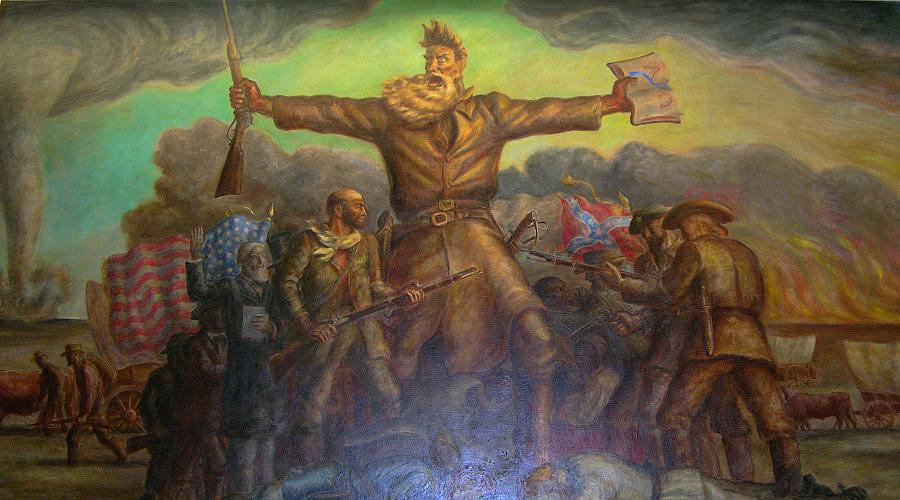
The mural depicted here is from the Kansas State House in
Topeka, and shows a raging, almost maniacal John Brown, the fiery abolitionist,
with a Bible one hand, and a rifle in the other. The fuel for Brown’s violent
rage was the institutionalized violence and injustice of slavery. Even for
those who believe violence is a useful tool in the service of justice making,
Brown engaged in violence in ways that were not rational, sometimes raiding (jayhawking)
the farms of Missouri residents (the nearest slave state) who had no slaves.
Brown is a complex person, and while I don’t condone his
violent choices, I admire his intense opposition to institutionalized violence.
And while his raid on Harper’s Ferry was a tragic fiasco, his death by hanging
was a catalyst in the coalescence of northern opposition to slavery. What is a
Mennonite pastor to think about such a fellow?
My abolitionist and Underground Railroad activist ancestor,
Quaker minister Thomas Frazier, likely would not have condoned Brown’s
violence, but some of his fellow Iowa Quakers provided Brown with critical
support. Frazier and other Quakers were quite willing to violate the Fugitive
Slave Act, which got them in trouble with the law, but going into slave states
and bringing freed slaves back across the border was another matter. Brown and
other raiders would do so, and once slaves were across the border, Quaker
Underground Railroaders were willing to help out. The relationship between the
likes of John Brown and the likes of my great, great, great, great grandfather,
were complex. While they disagreed on methods of confronting slavery, they
shared abhorrence of that form of institutionalized violence. Those Quakers
seemed aware that peace in the abstract was not peace at all.
Some of the most surprising conversations in my life were
with those advocating an armed struggle against oppression in the Philippines.
I say surprising because it seems like another life time. As a pacifist these
discussions quickly focused on my position that armed struggle against
oppression is wrong. Always. The return from my interlocutors was my pacifism
is rooted in privilege and is a luxury, enjoyed on my part by failing to confront the
institutionalized social, economic and political violence against the poor of
the Philippines, which is to say the majority of the people. Furthermore my
place of privilege is sustained by violence. My pacifism is both disingenuous and
hypocritical.
Those conversations do not change my conviction that a “refusal
to bear the sword” is the faithful Christian ethic. But they do make me highly
suspicious of peace in the abstract, of cheap peace, as if we are morally pure
just by throwing the word around. Without a context, the word peace becomes not
only weak, but dangerous, in that it can be used as a mask hiding greater and
deeper violence than that which it claims to oppose, or build barriers to
conversations which might increase understanding.
As long as peace remains nothing more than an abstract concept,
it isn’t peace at all. As Jeremiah and Ezekiel would say, it amounts to shouting peace when there is no peace.
Wednesday, July 10, 2013
And Wednesday after Jeopardy!
The New York Times reported today that televised prime time presidential addresses are mostly a thing of the past. Fifty years ago, if a president wanted to communicate an important message to as much of the nation as possible, an Oval Office speech interrupting regular network programming was the way to go. Now? Not so much. We have so many other ways to occupy our time than watch the president, from hundreds (thousands?) of cable channels, to the infinite world of the internet.

Compared to the good old days when network television dominated American screen time, a fraction of us watch live prime time presidential speeches today. Does this mean people don't care about the presidency? What the president says? Thinks? Perhaps. Has the president given up trying to communicate with the American people? Certainly not.
We learn what's on the president's mind through a variety of media, some of which did not exist five years ago, and often on our own time and at our own convenience.
At the grocery store once, a woman stopped me and asked if I was Phil Waite. "You don't know me," she said, "and I attend Waterford Mennonite, but I watch the College Mennonite telecast at Greencroft every Wednesday after Jeopardy."
The worship equivalent of the prime time Oval Office speech is the sanctuary on Sunday morning. But like the presidential speeches on network television, the saints gathered on Sunday morning are an increasingly small percentage of the whole worshipping community. At College Mennonite, most of us engaged in worship are not in the sanctuary, and many of us or not participating on Sunday morning.

Some of us listen on the radio before coming to Sunday School. Others watch at Greencroft. Travelers sometimes listen to the WGCS broadcast on their smart phones. Snow birds gather in Florida to watch on-line. Some of us on Sunday morning have never been to College Mennonite, or even to Goshen.
I put on my chicken little voice from time to time and complain about the decline in worship attendance. In some ways decline is a more hopeful frame because it leaves open the possibility of going in reverse, restoring what used to be. But restoring what used to be is not a choice available to us. Not only has the world around us changed, we have changed. Maybe a more helpful response is to take a step back and observe change, not decline, and to consider what new opportunities these changes bring.
Compared to the good old days when network television dominated American screen time, a fraction of us watch live prime time presidential speeches today. Does this mean people don't care about the presidency? What the president says? Thinks? Perhaps. Has the president given up trying to communicate with the American people? Certainly not.
We learn what's on the president's mind through a variety of media, some of which did not exist five years ago, and often on our own time and at our own convenience.
At the grocery store once, a woman stopped me and asked if I was Phil Waite. "You don't know me," she said, "and I attend Waterford Mennonite, but I watch the College Mennonite telecast at Greencroft every Wednesday after Jeopardy."
The worship equivalent of the prime time Oval Office speech is the sanctuary on Sunday morning. But like the presidential speeches on network television, the saints gathered on Sunday morning are an increasingly small percentage of the whole worshipping community. At College Mennonite, most of us engaged in worship are not in the sanctuary, and many of us or not participating on Sunday morning.
Some of us listen on the radio before coming to Sunday School. Others watch at Greencroft. Travelers sometimes listen to the WGCS broadcast on their smart phones. Snow birds gather in Florida to watch on-line. Some of us on Sunday morning have never been to College Mennonite, or even to Goshen.
I put on my chicken little voice from time to time and complain about the decline in worship attendance. In some ways decline is a more hopeful frame because it leaves open the possibility of going in reverse, restoring what used to be. But restoring what used to be is not a choice available to us. Not only has the world around us changed, we have changed. Maybe a more helpful response is to take a step back and observe change, not decline, and to consider what new opportunities these changes bring.
Subscribe to:
Posts (Atom)